
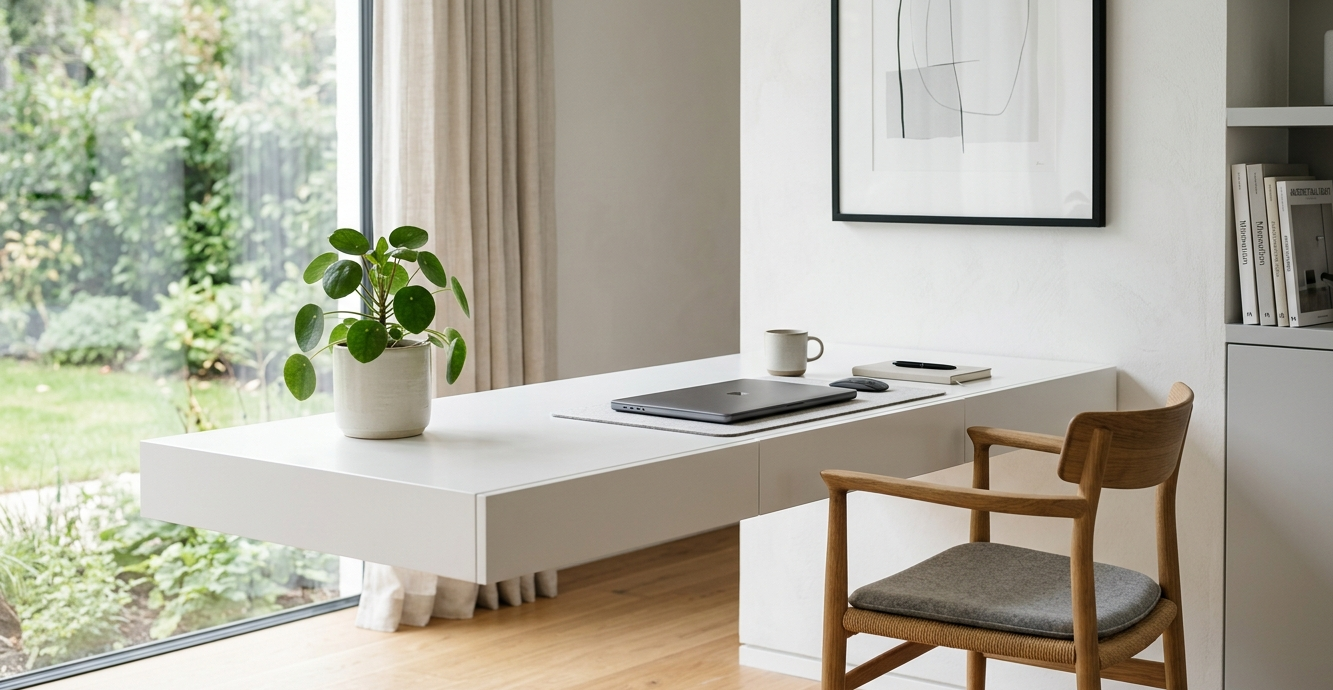
Today, my approach is defined by the “breathable room.” A minimalist home office setup for productivity and aesthetic isn’t about having nothing; it’s about having exactly what you need, curated with such intention that the space itself fosters mental clarity. Minimalist design is the quiet luxury of the modern professional.
The Evolution of Minimalist Workspaces: From Sterile to Soulful
Minimalism in the office hasn’t always been this inviting. In the late 90s, it was clinical—all cold glass and brushed steel. However, the modern minimalist movement has shifted toward “Warm Minimalism.” We’ve traded the sterile cubicle look for organic textures, soft curves, and a deep connection to the natural world.
The goal of a high-design office is to eliminate “visual noise.” Every stray cable, mismatched folder, or unnecessary knick-knack is a micro-distraction. By curating a workspace that prioritizes spatial flow, we allow the brain to enter a “flow state” much faster.
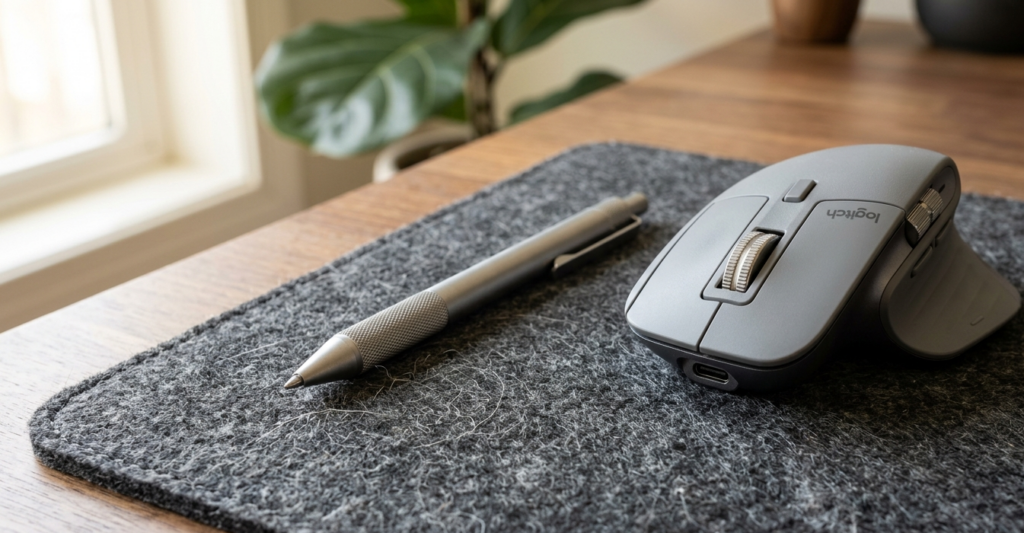
The Foundation: Elements of a High-Design Workspace
To achieve a professional yet personal minimalist setup, we must focus on three pillars: Form, Function, and Feeling.
1. Spatial Flow and Layout
In my experience, the biggest mistake people make is pushing their desk against a wall. If space permits, try a “command position” where your back is to a solid wall and you have a clear view of the door and the room. This creates a psychological sense of security and openness.
2. The Focal Point
Every room needs an anchor. In a minimalist office, the desk is your altar of productivity. Choose a piece with clean lines and hidden cable management. When the desk is clear, the mind follows.
Deep Dive: The Sensory Palette—Color, Texture, and Fabric
In my experience of residential styling, I’ve found that a minimalist room lives or dies by its textural contrast. Without texture, minimalism feels cheap; with it, it feels curated.
The Color Psychology of Productivity
We aren’t just looking for “white.” We are looking for depth. A truly sophisticated minimalist palette uses tonal variations to create warmth.
- The Foundation (The 60%): Use a soft, “greige” or bone white.
- Hex Suggestion: #F5F5F0 (Off-White/Parchment)
- The Grounding Element (The 30%): Natural wood tones or muted clay.
- Hex Suggestion: #A68966 (Raw Oak)
- The Accent (The 10%): High-contrast charcoal or deep forest green to draw the eye.
- Hex Suggestion: #2F363F (Slate Charcoal)
Textures and Fabrics: Beyond the Surface
When you strip away the “stuff,” the materials you keep must be exceptional. I always recommend incorporating at least three different textures to keep the room from feeling “flat.”
- Bouclé and Linen: For seating, I adore a heavy-weight linen or a subtle bouclé. These fabrics catch the light beautifully and provide a tactile softness that counters the hard edges of a desk.
- Natural Stone: A travertine tray or a marble coaster adds a weight of “permanence” to the desk. It feels grounded.
- Matte Metals: Avoid high-shine chrome. Instead, look for brushed bronze or blackened steel. These materials absorb light rather than reflecting it, reducing eye strain.
Lighting: The Invisible Designer
You can spend $10,000 on furniture, but if your lighting is off, the room will feel cold. Minimalism thrives on layered lighting.
- Ambient Light: Natural sunlight is the gold standard. I always suggest sheer linen curtains that blur the outside world while bathing the room in a soft glow.
- Task Lighting: A sculptural desk lamp isn’t just a tool; it’s a piece of art. Look for a lamp with a warm color temperature (around 2700K to 3000K).
- Accent Light: A small, rechargeable LED light tucked into a bookshelf can create a sense of depth and evening “mood” for those late-night brainstorming sessions.
The Curator’s Choice: 5 Essential Minimalist Elements
As a designer, I am often asked for specific recommendations. Here is my “Short List” for a high-design office.
| Item | Why It Works | Styling Tip |
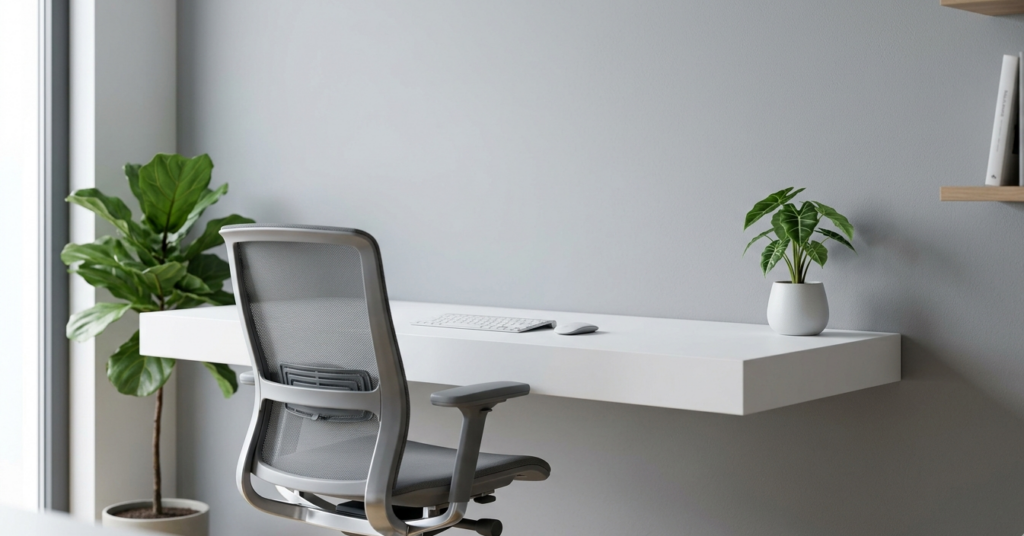
| The Floating Desk | Maximizes floor space, making small rooms feel massive. | Pair with a cord-management raceway hidden underneath. |
| Ergonomic Sculptural Chair | Bridges the gap between “office furniture” and “fine art.” | Choose a neutral tone like sand or slate to blend with the walls. |
| Natural Fiber Rug | Adds acoustic dampening and organic texture. | A flat-weave jute or wool rug keeps the look clean and structured. |
| The Modular Shelf | Keeps “visual clutter” organized and intentional. | Use the 1/3 rule: 1/3 books, 1/3 objects, 1/3 empty space. |
| The Oversized Ceramic Vase | Adds a singular, bold organic shape to the room. | Fill with a single dried branch (like Eucalyptus) for height. |
You might also enjoy:
- Timeless Interior Design: 7 Principles That Never Age
- Eco-Friendly Elegance: Sustainable Home Decor Guide
- Nature Indoors: Guide to Biophilic Interior Design
Beyond the Office: Room-by-Room Minimalist Application
The minimalist philosophy shouldn’t end at your office door. To maintain a productive lifestyle, “visual peace” should flow through the entire home.
The Living Room: The Breathable Social Space
In the living room, minimalism is about edited comfort. I often replace cluttered coffee tables with a single, large-scale ottoman. Use a monochromatic color palette but vary the fabrics—a velvet sofa with a wool throw and silk pillows. This creates a “quiet luxury” look that feels cohesive with your workspace.
The Bedroom: The Sanctuary of Sleep
The office is for “On,” the bedroom is for “Off.” To mimic the minimalist office’s success, remove all electronics. Focus on low-profile bed frames and hidden storage. A “floating” nightstand creates an airy feel that makes the room seem larger and more serene.
The Kitchen: Functional Simplicity
I am a huge proponent of the “clear counter” policy. In a minimalist kitchen, the materials—like a waterfall quartz island or custom cabinetry—are the stars. Keep only the most beautiful appliances on display and hide the rest. This reduces the mental load when transitioning from “work mode” to “life mode.”
Pros and Cons: The Reality of Minimalist Design
Every design choice involves a trade-off. Here is what I tell my clients before we commit to this aesthetic.
Pros
- Reduced Decision Fatigue: When everything has a place, you spend less time searching and more time creating.
- Timeless Aesthetic: Minimalism doesn’t go out of style. You won’t feel the need to “re-do” your office in three years.
- Enhanced Focus: A minimalist home office setup for productivity and aesthetic directly impacts your ability to concentrate.
Cons
- Upkeep is Vital: In a room with few items, a single stray coffee mug becomes a glaring eyesore.
- The “Cold” Risk: If you don’t incorporate the textures I mentioned (wood, fabric, stone), the room can feel uninviting.
- Initial Cost: High-quality minimalist furniture is often more expensive because the joinery and materials cannot be hidden by “fluff.”
Expert Tip: The “One In, One Out” Rule
The Curator’s Discipline. Every time you bring a new book, gadget, or accessory into your office, one thing must leave. This ensures your space remains a reflection of your current goals, not a graveyard of past projects.
Conclusion: Designing Your Focus
Your home office is more than just a place to work; it is a physical manifestation of your professional standards and your personal peace. By choosing a minimalist home office setup for productivity and aesthetic, you are choosing to prioritize your mental well-being and your creative output.
Start small. Clear your desk today. Keep only what inspires you. You’ll be amazed at how much louder your ideas become when the room finally stops shouting.