
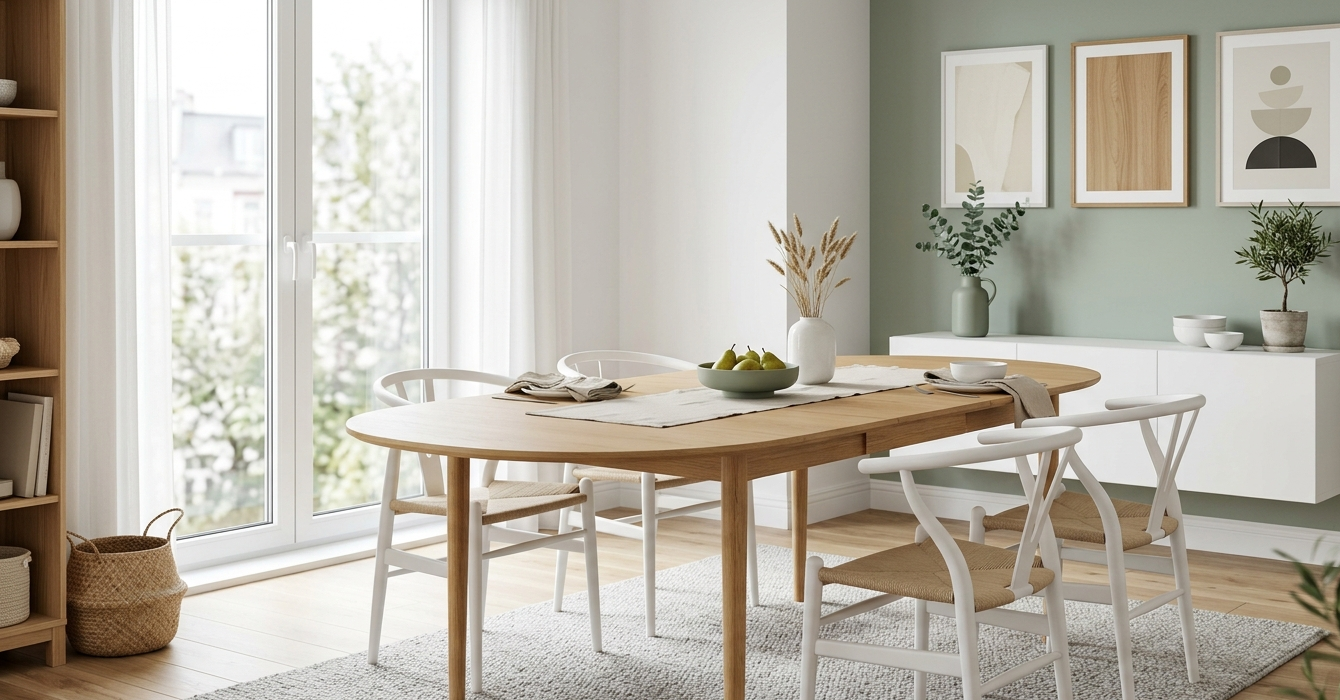
In my experience, a small floor plan isn’t a limitation—it’s an invitation to be more intentional. Today, as we navigate the design landscape of 2026, the demand for space-saving dining tables for narrow kitchen areas has reached a fever pitch. We are no longer settling for clunky, “functional-only” furniture. We want pieces that breathe, adapt, and serve as the soulful focal point of our homes.
The Evolution of the Compact Dining Experience
Historically, the dining room was a static, formal environment. However, as urban living has densified, our furniture has had to become smarter. In 2026, the trend has shifted from “minimalism” to “essentialism.” We aren’t just trying to have less; we are trying to have better.
Modern engineering has finally caught up with high-end aesthetics. We are seeing a move away from the “card table” feel of the past toward “origami-inspired” designs. These pieces utilize spatial flow to ensure that even when a table is tucked away, it contributes to the room’s visual harmony rather than looking like an afterthought.
Key Elements of Contemporary Small-Scale Design
- Visual Weight: Choosing pieces with thin legs or glass tops to keep the “sightlines” clear.
- Multi-functionality: A table that serves as a prep station, a desk, and a dinner party hub.
- Adaptive Geometry: Round tables for flow; rectangular drop-leaves for wall-hugging efficiency.
Mastering the Narrow Kitchen: A How-To Guide
When I consult with clients on narrow layouts, I always start with the Golden Triangle of Flow. You need enough clearance (usually 36 inches) to pull out a chair without hitting a wall. If you don’t have that, we look at unconventional placements.
Choosing Your Materiality
The material you choose dictates the “vibe” and the perceived size of the room.
- Natural Woods: Bring warmth and organic texture.
- Acrylic and Glass: Virtually disappear, making them perfect for ultra-tight spots.
- Powder-Coated Metals: Add an industrial edge and are incredibly durable for high-traffic kitchens.
Deep Dive: Textures, Palettes, and Fabrics for 2026
In a small space, every square inch of surface area is a design opportunity. I’ve found that the “secret sauce” to making a tiny dining nook feel luxurious is textural contrast.
The 2026 Color Palette
For 2026, we are moving away from the cold grays of the last decade. We are embracing “Earthbound Sophistication.” Here are the HEX codes I am currently obsessed with for small dining areas:
- Warm Alabaster (#F2EFE9): Use this for walls to bounce light without the clinical feel of pure white.
- Muted Terracotta (#C38D7D): A beautiful “grounding” color for upholstery or table runners.
- Deep Moss (#4A5D4E): Ideal for an accent wall or velvet dining chairs to add depth.
- Soft Champagne (#D4AF37): Use for hardware and lighting fixtures to add a touch of “quiet luxury.”
Texture and Fabric Choices
When selecting fabrics for small dining chairs or benches, I always recommend performance velvets or bouclé.
- Bouclé: The looped fibers create a wonderful textural contrast against a smooth wooden or marble table.
- Linen Blends: These offer a relaxed, breezy aesthetic. If your dining area is in a sunny narrow kitchen, linen reflects the light beautifully.
In my styling practice, I often layer a jute rug under a small round table. The ruggedness of the jute against the polished surface of the table creates a sophisticated tension that draws the eye, making the “dining zone” feel like a distinct architectural “room” within a larger space.
The Curator’s Choice: Top 5 Space-Saving Solutions for 2026
After testing hundreds of pieces for my clients this year, these are the five “heroes” of small-space living.
1. The “Invisible” Console-to-Dining Table
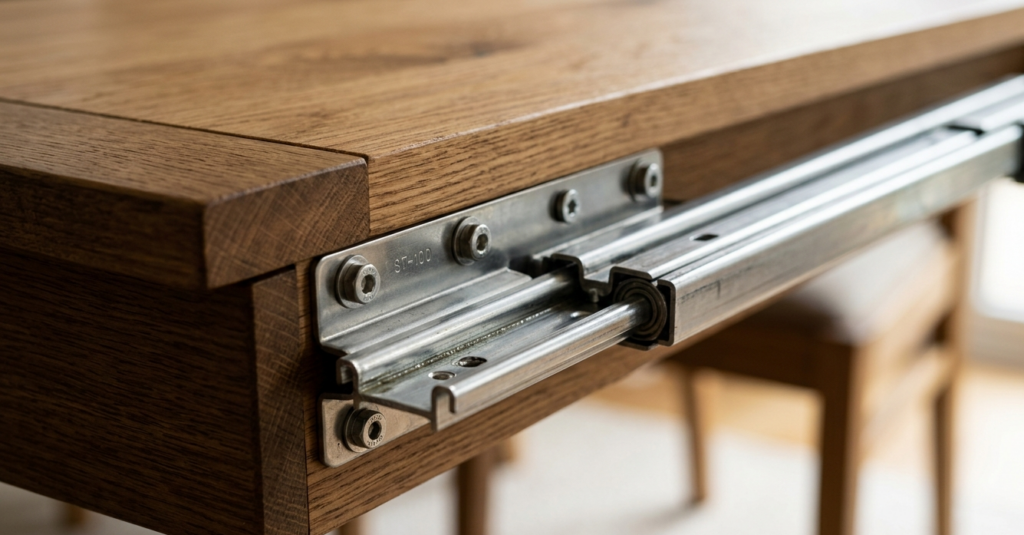
This is the ultimate transformer. By day, it’s a 15-inch deep console table behind your sofa or in your entryway. By night, it utilizes a hidden track system to expand into a table that seats six.
- Best for: Studio apartments.
- Style Tip: Pair with folding wooden chairs that can be hung as “wall art” when not in use.
2. The Scandinavian Drop-Leaf Gateleg
A classic for a reason. In 2026, these are being reimagined with integrated storage drawers in the center “spine” for linens and flatware.
- Best for: Narrow kitchen corridors.
- Material: Look for solid birch or oak for longevity.
3. The Pedestal Round Table (Butterfly Leaf)
Pedestals are superior in small spaces because they eliminate “leg clutter,” allowing you to squeeze in an extra guest without anyone bumping knees.
- Best for: Creating a soft focal point in a corner.
- Curator’s Note: I love a marble-topped version to add a sense of permanent elegance.
4. The Wall-Mounted “Floating” Desk/Table
If you literally have zero floor space, go vertical. A high-quality wall-mounted leaf can be flipped up for breakfast and folded flat against the wall afterwards.
- Best for: Ultra-narrow “galley” style kitchens.
5. The Nested Bistro Set
In 2026, nesting isn’t just for side tables. We are seeing bistro tables where the chairs are curved to fit perfectly underneath the table’s radius, forming a solid, sculptural cylinder when tucked away.
- Best for: Balcony nooks or breakfast corners.
You might also enjoy:
- Solid Wood vs MDF Furniture: Is the Investment Worth It?
- Weather-Proof Your Patio: Durable Furniture Guide
- Storage with Style: Mid-Century Modern Sideboards
Room-by-Room Application: The Versatile Table
A great space-saving table shouldn’t be a “one-trick pony.” Here is how you can apply these principles across your home.
The Living Room
In an open-concept layout, your dining table often sits right against the living area. To maintain spatial flow, choose a table height that aligns with your sofa back. This creates a continuous visual plane that makes the room feel wider.
The Bedroom
I have often used a small, elegant drop-leaf table as a vanity or a desk in the bedroom. During the day, it holds your laptop and a chic lamp; on the weekend, it can be moved to the center of the room for a romantic “room service” style brunch.
The Kitchen
In the kitchen, the table must be a workhorse. Choose a table with a heat-resistant surface (like sintered stone or treated hardwood). This allows the table to act as an extra “island” for meal prep when you aren’t eating.
Pros and Cons: Aesthetics vs. Maintenance
When choosing your perfect table, it’s a balance of style and “lifestyle reality.”
| Feature | Pros (The “Wow” Factor) | Cons (The “Reality” Check) |
| Glass Tops | Opens up the room; looks incredibly high-end. | Requires daily cleaning; fingerprints are the enemy. |
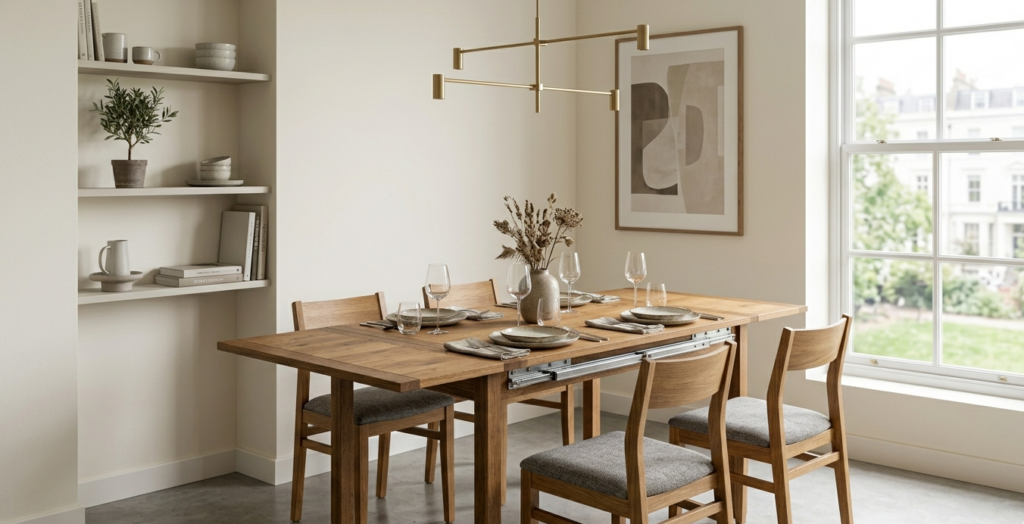
| Extendable Mechanisms | Amazing for hosting; hides the bulk when alone. | Can be heavy to move; leaves can sometimes have a slight gap. |
| Bold Colors | Creates a stunning focal point; shows personality. | Can “shrink” the room if the color is too dark or matte. |
| Wall-Mounted | Saves the most floor space; very modern look. | Limits where you can rearrange your furniture later. |
Lighting the Small Dining Area
Lighting is the “jewelry” of your dining space. In a narrow area, a massive chandelier will feel claustrophobic. Instead, I recommend:
- Slim Linear Pendants: They draw the eye upward and accentuate the length of a narrow table.
- Wall Sconces: If you can’t hang a light from the ceiling, a swing-arm sconce provides focused “mood” lighting without taking up table space.
Expert Tip: Always put your dining lights on a dimmer switch. In a small space, being able to shift from “bright task lighting” for prep to “soft candle-lit glow” for dinner is the easiest way to change the entire atmosphere of your home.
Conclusion: Crafting Your Sanctuary
Creating a beautiful dining experience has nothing to do with the square footage you own and everything to do with the atmosphere you curate. Whether it’s a sleek space-saving dining table for a narrow kitchen area or a clever extendable piece that grows with your guest list, the goal is to create a space that feels like you.
In my experience of design, I’ve found that the most memorable dinners happen around the smallest tables—where the elbows touch, the wine flows, and the conversation is intimate. Don’t wait for a bigger house to start living your most stylish life.