
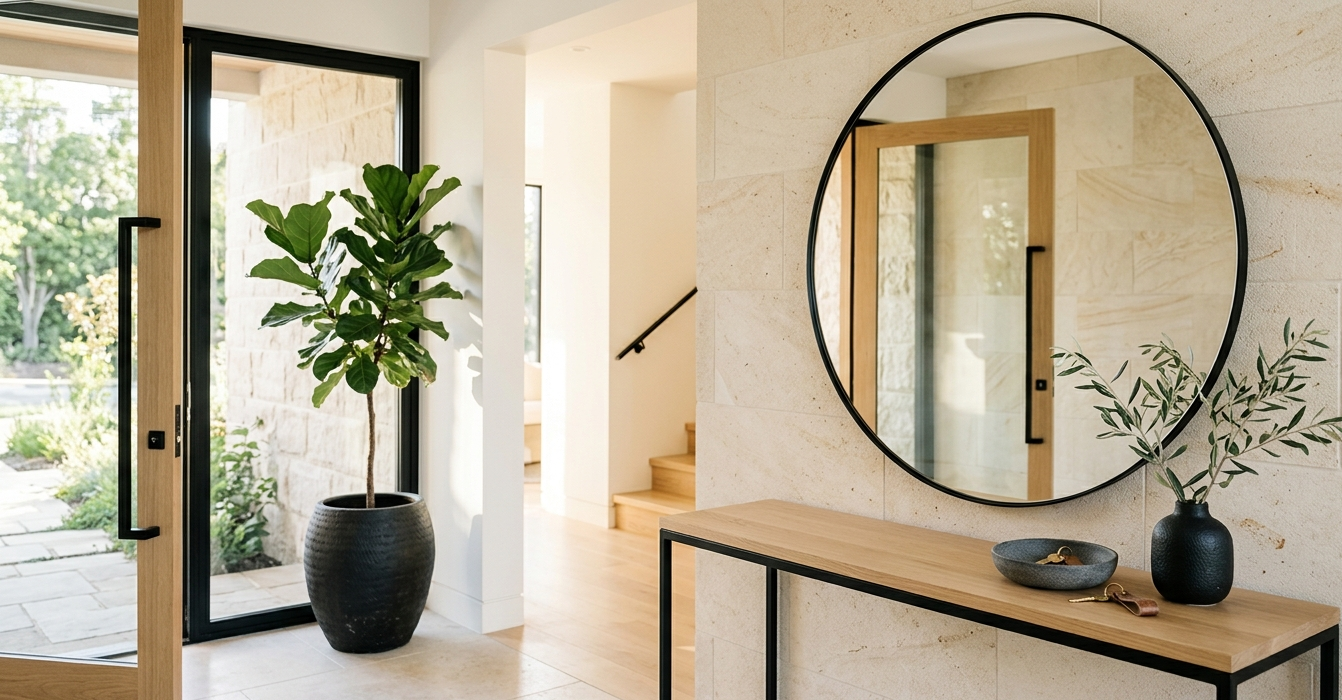
The entryway is more than just a transition zone; it is the narrative prologue of your home. It sets the tone for the rest of your interior and provides that essential ” exhale” moment when you return from a long day. If you are looking for entryway styling tips to create a great first impression, you aren’t just decorating a hallway—you are crafting an experience.
The Evolution of the Foyer: From Vestibule to Statement Space
Historically, the entryway (or vestibule) served a purely utilitarian purpose: a “buffer zone” to keep the cold air out and the heat in. In the grand estates of the 18th century, it was a place for servants to take coats. However, as residential architecture evolved, so did our emotional connection to this space.
Today, the entryway has become a high-traffic gallery. It is the one room every single guest will see, regardless of whether they stay for tea or a five-course meal. Modern spatial flow dictates that the entryway should act as a visual bridge, subtly hinting at the color palettes and textures found deeper within the home.
Establishing a Focal Point with Purpose
Every successful room needs an anchor. In an entryway, this is usually a console table, a built-in bench, or a statement pedestal.
Choosing Your Anchor Piece
In my experience, the scale of this piece is where most homeowners stumble. A tiny table in a large foyer looks lost, while a bulky dresser in a narrow hall creates a “bottleneck” effect. For a standard hallway, I recommend a slim-profile console (about 12–15 inches deep). This maintains spatial flow while providing a surface for styling.
The Psychology of Color and Light
Lighting is the “jewelry” of interior design. It’s the finishing touch that dictates the mood. When styling an entryway, I always advocate for layered lighting.
The Three Layers of Entryway Light:
- Ambient: A statement chandelier or flush mount.
- Task: A small table lamp on the console for a warm, low-level glow in the evening.
- Accent: Sconces flanking a mirror to highlight artwork.
Recommended Color Palettes
Color psychology plays a massive role in first impressions. If you want a “welcoming” feel, lean toward earthy neutrals or “hushed” tones. Here are three palettes I’ve curated for my clients:
| Vibe | Base Color | Accent 1 | Accent 2 | HEX Codes |
| The Serene Sanctuary | Soft Greige | Sage Green | Warm Brass | #D6CFC7, #98A08D, #B58F54 |
| The Modern Classic | Crisp White | Navy Blue | Matte Black | #F8F9FA, #1D3557, #212529 |
| The Organic Earth | Terracotta | Cream | Deep Oak | #B06C49, #F5F5DC, #4B3621 |
Mastering Textural Contrast
One of the most overlooked entryway styling tips to create a great first impression is the use of texture. If every surface is hard (wood floors, drywall, glass table), the space feels sterile. You need textural contrast to soften the acoustics and add visual depth.
Fabric and Material Deep Dive
In my styling practice, I look for three specific “texture pillars”:
- The Rug: A vintage-inspired runner or a chunky jute rug adds immediate warmth. It provides a tactile transition from the hard exterior ground to the soft interior home.
- The Textiles: If you have a bench, add a linen or velvet throw pillow. This suggests comfort and invites guests to sit.
- The Greenery: Never underestimate the “texture” of life. A tall fiddle-leaf fig or a vase of textured pampas grass breaks up the linear lines of furniture.
The Power of Reflection: Using Mirrors
A mirror is an entryway’s best friend. Not only does it allow for a last-minute lipstick check, but it also bounces light into often-dim hallways.
Pro Tip: Position your mirror so it reflects something beautiful—like a piece of art or a window—rather than a cluttered closet door or a bathroom. A large circular mirror is particularly effective at breaking up the “boxiness” of a rectangular hallway.
You might also enjoy:
- How to Arrange a Narrow Living Room Layout Flawlessly
- Dining Room vs. Breakfast Nook: Which is Best?
- Studio Living: Best Room Divider Ideas for Layouts
Curation Over Clutter: “The Curator’s Choice”
When I style a home, I don’t just “buy stuff.” I curate. Here are five essential entryway accessories that combine form and function:
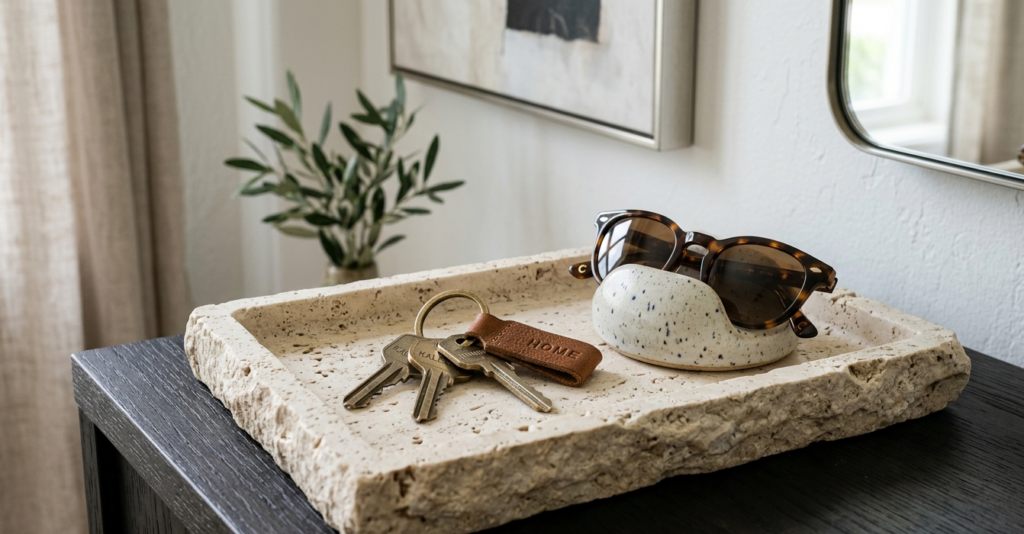
1. The Statement Tray
A marble or leather tray is essential for “corralling.” It turns a messy pile of keys and sunglasses into a deliberate design choice. It creates a “home for the homeless” items.
2. The Sculptural Vase
Don’t settle for a basic glass jar. Look for something with an organic shape—terracotta, hammered metal, or frosted glass. Even when empty, it acts as a piece of sculpture.
3. The Scent Story
Scent is the strongest link to memory. I always place a high-quality reed diffuser or a candle in the entryway. Scents like sandalwood, bergamot, or fresh linen signal to the brain that “you are home.”
4. The Oversized Art Piece
Instead of a gallery wall of small photos (which can look cluttered in a small hall), go for one large, impactful piece of abstract art. It creates a singular focal point that captures the eye immediately.
5. The Functional Basket
Woven seagrass or wicker baskets tucked under a console table are the “secret weapons” of organized homes. They provide a place for umbrellas, scarves, or “out-the-door” shoes while adding a rustic, organic texture.
Creating a “Sensory Hello”
When a guest walks in, they should experience a “sensory hello.” This is achieved through the balance of sight, touch, and smell.
- Sight: The organized beauty of your focal point.
- Touch: The softness of a runner underfoot.
- Smell: Your signature home fragrance.
I have found that homes that focus on all three senses feel significantly more “expensive” and well-thought-out than those that only focus on the visual.
Applying Entryway Principles Room-by-Room
The “Entryway Philosophy”—that first impressions and functional beauty are paramount—can be applied throughout the house.
The Living Room
Just as the entryway has a focal point, the living room needs one that isn’t always the television. Use a fireplace or a large window. Ensure the spatial flow allows for easy movement around seating areas.
The Bedroom
Apply the “Textural Contrast” rule here. Mix silk pillows with a chunky wool knit throw. Use the “Scent Story” concept by keeping lavender-scented items near the bedside to signal relaxation.
The Kitchen
The kitchen “entry” (often from the garage or mudroom) is usually the most cluttered. Apply the “Corral” technique here: use a beautiful wooden board to hold oils and spices, turning utility into a display.
Pros and Cons of Entryway Styling
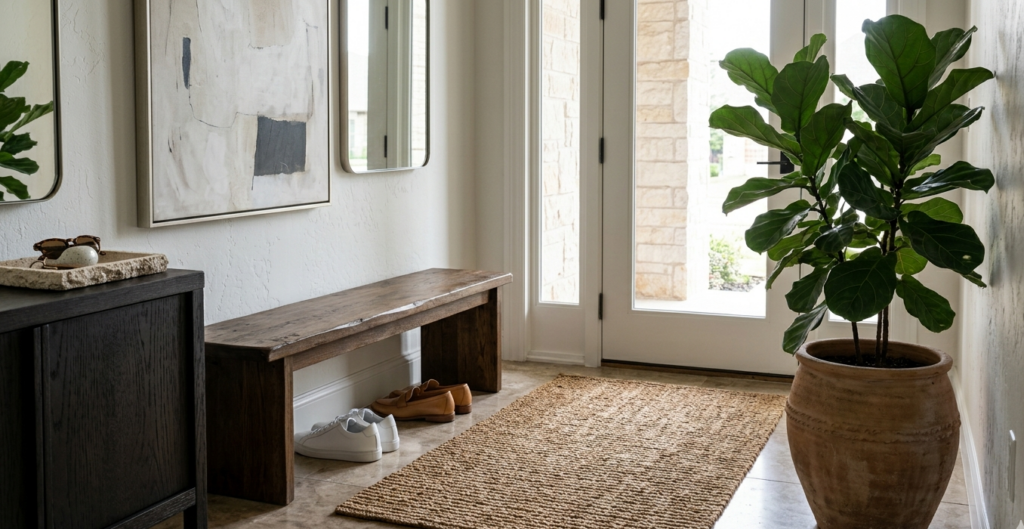
Designing an entryway is a balancing act between the “Magazine Look” and “Real Life.”
| Feature | Pros (Style & Aesthetic) | Cons (Maintenance & Function) |
| Open Console Styling | Creates an airy, high-end look; showcases decor. | No hidden storage; dust accumulates quickly on lower shelves. |
| Light-Colored Rugs | Brightens the space; feels luxurious. | Shows dirt and footprints instantly in high-traffic areas. |
| Mirrored Furniture | Bounces light; makes small halls feel huge. | Needs constant cleaning to remove fingerprints. |
| Minimalist “No-Shoes” Look | Looks pristine and editorial. | Can be inconvenient for guests; requires a hidden shoe solution. |
Deep Dive: Mastering the Details
The Material Mix
In my years of styling, I’ve developed a “Rule of Three” for materials. To achieve a professional look, your entryway should feature:
- Something Natural: Wood, stone, or clay.
- Something Metallic: Brass, black iron, or chrome.
- Something Soft: A rug, a pillow, or a textile wall hanging.
When you mix these, you create a “lived-in” luxury. For example, a black iron console (Metallic) with a reclaimed wood top (Natural) paired with a wool runner (Soft) is a foolproof combination.
Fabric Selections for Durability
Since the entryway is a high-traffic zone, your fabric choices matter. If you have a bench, I recommend performance fabrics or outdoor velvets. These look incredibly high-end but can be wiped down if someone sits with a damp coat. For rugs, low-pile vintage Persians are my go-to. They are virtually indestructible and the intricate patterns hide the inevitable “life” that gets tracked in.
Conclusion: Your Home’s Handshake
The entryway is your home’s handshake. It’s the first thing you see when you arrive and the last thing you see when you leave. By focusing on spatial flow, textural contrast, and a clear focal point, you transform a mere hallway into a welcoming sanctuary.
In my experience, the most beautiful entryways aren’t the ones that cost the most money—they are the ones that reflect the personality of the people living inside. Don’t be afraid to add a personal touch, like a bowl of sea glass from your favorite vacation or a framed sketch by a friend.
The Expert Tip:
Always “edit” your entryway once a week. Because this space is a magnet for clutter, take five minutes every Sunday to clear off the mail, put away stray shoes, and refresh the water in your flower vase. A clean entryway is a welcoming entryway.