
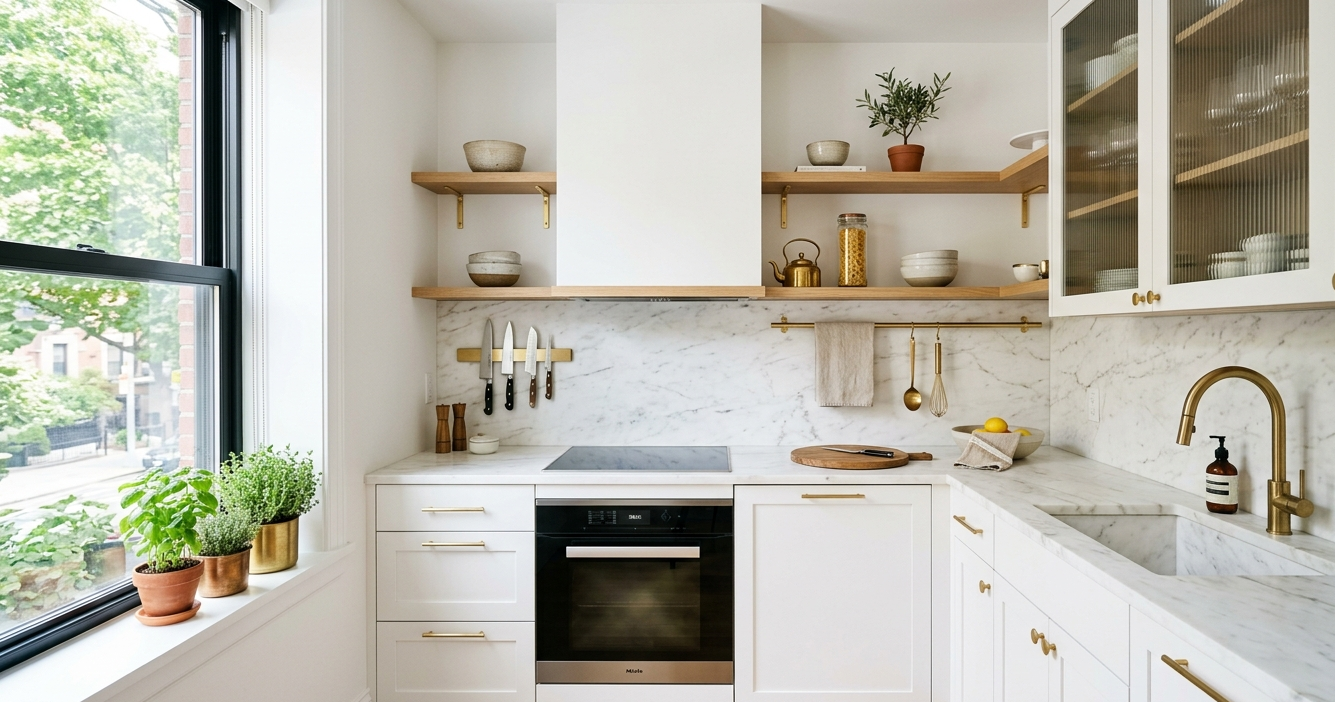
In this guide, we’re going to explore how to turn your cramped cooking quarters into a high-end culinary sanctuary.
The Evolution of the “Compact Culinary” Aesthetic
Historically, the kitchen was a utilitarian “back-of-house” space, hidden away from guests. In the Victorian era, kitchens were often cramped and dark, prioritized for function over form. It wasn’t until the mid-20th century, with the rise of the “Frankfurt Kitchen” (designed by Margarete Schütte-Lihotzky), that designers began to treat the kitchen as a laboratory of efficiency.
Today, we are seeing a shift toward “The Jewel Box Kitchen.” This philosophy suggests that if a space is small, every inch should be treated with the luxury of a jewelry box—high-quality materials, intentional lighting, and a cohesive color story. When we apply small kitchen decor hacks to maximize counter space, we aren’t just hiding the toaster; we are curating an experience.
The Science of Sightlines: Why Counter Space Matters
In interior design, the “focal point” of a kitchen is rarely the stove; it is the horizontal planes. When your counters are cluttered, the “visual noise” creates a sense of anxiety. By clearing these surfaces, we create textural contrast between the sleekness of the countertop (be it marble, quartz, or butcher block) and the decorative elements surrounding it.
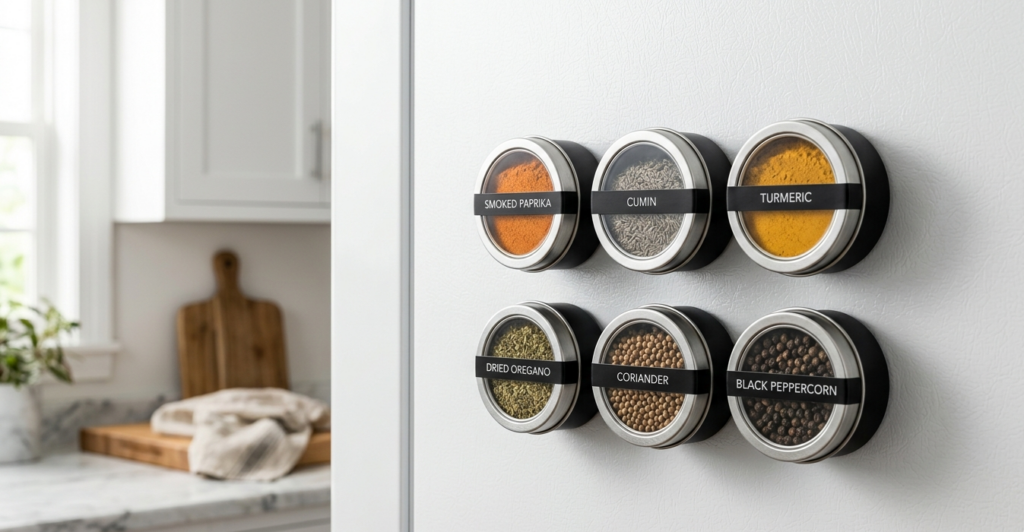
1. The Vertical Revolution: Magnetic and Wall-Mounted Systems
In my experience, the biggest mistake homeowners make is treating walls as “dead space.” To save your counters, you must move upward.
- Magnetic Knife Strips: Instead of a bulky knife block, a walnut or stainless steel magnetic strip adds a professional, “chef’s kitchen” vibe.
- The Rail System: Look for high-end brass or matte black rails. Hanging copper ladles or dried herbs adds a layer of organic texture while keeping the workspace clear.
2. The Sink Cover Strategy (The “Hidden” Counter)
If you have a single or double-bowl sink, you are sitting on a goldmine of unused surface area. Custom-fitted walnut cutting boards that sit over the sink transform a “void” into a workspace. This is a classic example of functional styling.
Deep Dive: The Color Palette & Texture Symphony
Design is as much about what you see as how you feel. In a small kitchen, your color palette can either make the walls recede or make them feel like they are leaning in.
The “Luminous Minimalist” Palette
To maximize the sense of airiness, I recommend a palette that leans into specular reflection (how light bounces off surfaces).
- Base Neutral: Alabaster White (Hex: #F2F0E8). This isn’t a stark hospital white; it has a hint of warmth that prevents the room from feeling clinical. Use this for cabinetry.
- The Accent Tone: Ethereal Sage (Hex: #A3AF97). Sage green provides a connection to nature. Use this for backsplashes or linens to create a biophilic connection.
- The Hardware/Contrast: Champagne Bronze (Hex: #B7926C). Gold and bronze tones act as the “jewelry” of the room.
Texture and Fabric Selection
I have found that small kitchens often feel “hard”—too many cold surfaces like tile and stone. To balance this, we need textural softness.
- Linen Window Treatments: Avoid heavy blinds. A sheer, flax-colored linen café curtain allows light to filter through while adding a soft, organic ripple.
- Jute or Sisal Runners: A textured rug underfoot provides a break from the hard flooring. It defines the “walking path,” enhancing the spatial flow.
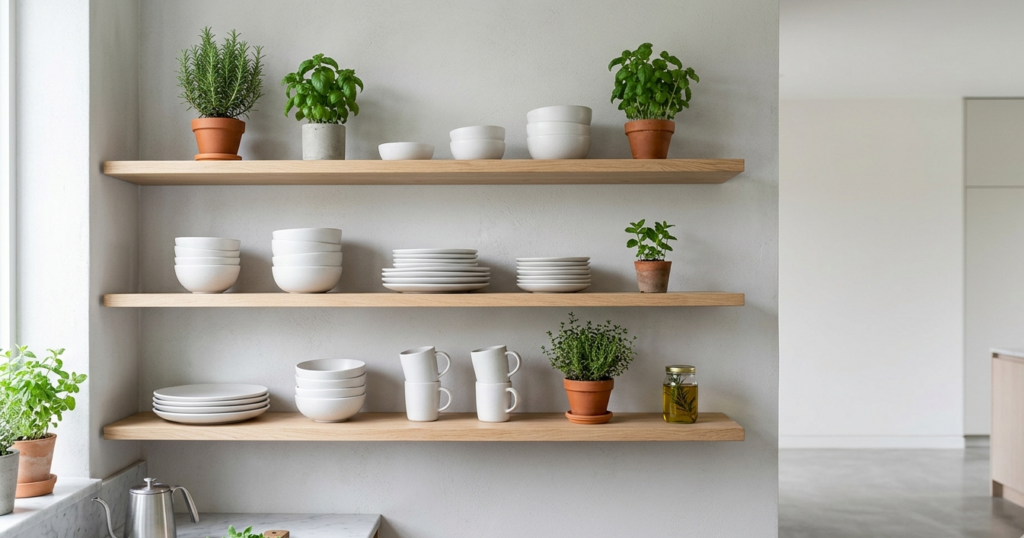
- Stone vs. Wood: Pair a cold marble countertop with a warm white oak floating shelf. This textural contrast ensures the kitchen feels curated rather than sterile.
You might also enjoy:
- How to Arrange a Narrow Living Room Layout Flawlessly
- Timeless Gender-Neutral Nursery Ideas & Decor
- The Ultimate Guest Bedroom Essentials Checklist
The Curator’s Choice: 5 Accessories for the Style-Conscious Kitchen
As a designer, I don’t just look for “storage”; I look for pieces that tell a story. Here are my top five selections for maximizing style in a small footprint:
- The Tiered Marble Pastry Stand: * The Hack: Instead of letting fruit and bread clutter the counter, use a tiered stand to go vertical. The marble adds a high-end material note, while the tiers save 60% of the horizontal footprint.
- The Integrated “Appliance Garage”: * The Hack: If you are doing a minor refresh, consider a small tambour-door cabinet that sits on the counter. It hides the coffee maker and toaster when not in use, creating a “clean slate” look.
- The Artisanal S-Hook: * The Hack: Cheap plastic hooks ruin the aesthetic. Invest in hand-forged iron or polished brass S-hooks. Use them on a wall rail to hang everything from mugs to colanders.
- The Under-Cabinet Lighting Kit (Warm Temp): * The Hack: Counter space looks bigger when it is well-lit. Use 2700K (warm) LED strips. This eliminates shadows, making the “visual depth” of the counter seem greater.
- The Pedestal Bowl: * The Hack: Elevating items—even just a bottle of dish soap and a sponge—on a small stone pedestal makes them look like a “vignette” rather than clutter.
Small Style Across the Home: Room-by-Room Application
The principles we use for small kitchen decor hacks to maximize counter space are actually universal design truths. Here is how they translate to other areas of the home:
The Living Room
Just as we move kitchen items to the walls, we can use “floating” furniture in the living room. A floating media console or wall-mounted bookshelves keeps the floor clear, which is the “counter space” of the living room. Maintaining a clear line of sight to the floorboards makes a small room feel infinitely larger.
The Bedroom
In the bedroom, the nightstand is your “counter.” To maximize this space, replace table lamps with wall-mounted sconces. This frees up the surface for a book or a glass of water, mimicking the “decluttered counter” philosophy. Use the same textural contrast we discussed—pair a sleek metal sconce with a soft, velvet headboard.
The Bathroom
The bathroom vanity is perhaps the only place more prone to clutter than the kitchen. Apply the “Pedestal” hack here: use a small tray to group your skincare. This creates a focal point and makes the remaining counter space feel intentional and wide.
Pros and Cons: Visual Style vs. Functional Maintenance
| Feature | Pros (The Style Win) | Cons (The Functional Reality) |
| Open Shelving | Creates an airy, expansive feel; showcases beautiful ceramics. | Requires frequent dusting; necessitates “perfect” organization of dishes. |
| Monochromatic Palette | Makes the kitchen feel like one continuous, large space. | Can feel flat if you don’t incorporate enough textural contrast. |
| Integrated Appliances | Provides a seamless, high-end “custom” look. | Can be more expensive to replace; requires specific cabinetry dimensions. |
| Wall-Mounted Rails | Frees up drawer and counter space; easy access to tools. | Can look cluttered if over-packed; items may collect grease/dust. |
Implementing the “Big Style” Philosophy
Lighting as a Spatial Tool
I cannot overstate the importance of lighting in small spaces. In my experience, a single overhead light is the enemy of a small kitchen. It creates harsh shadows in the corners, effectively “shrinking” the room.
- Layering: Combine recessed ceiling lights (ambient), under-cabinet strips (task), and a statement pendant over the sink (accent).
- The Golden Rule: Always choose “Warm White” bulbs. Cool white light can make your beautiful Alabaster White cabinets look blue and sterile.
The Power of Scent and Sound
Design is multisensory. To make a small kitchen feel like a luxury destination, consider the “invisible decor.” A high-end reed diffuser with notes of Mediterranean Fig or Santal adds a layer of sophistication that transcends physical space.
Expert Implementation: Step-by-Step
If you are staring at your cluttered counter right now, here is how I suggest you begin:
- The “Edit”: Remove everything from your counters. Everything.
- The 50% Rule: Only 50% of the counter should ever be occupied. If you have 10 feet of counter, 5 feet should be completely bare.
- Choose Your Hero: Pick one beautiful item—a Le Creuset dutch oven or a marble mortar and pestle—to stay on the counter as a focal point.
- Go Vertical: Install that brass rail or magnetic strip.
- Audit Your Color: If your small kitchen feels “busy,” it’s likely because there are too many colors competing. Stick to the Luminous Minimalist palette mentioned above.
Common Pitfalls to Avoid
In my years of consulting, I’ve seen these two mistakes ruin even the best small kitchen decor hacks:
- Over-Accessorizing: Just because you can hang everything on a rail doesn’t mean you should. Leave “breathing room” between hanging items.
- Ignoring the Ceiling: In a small kitchen, painting the ceiling the same color as the walls (or one shade lighter) can erase the “horizon line,” making the room feel taller.
Conclusion: The Joy of the “Edit”
Creating a high-style, high-function kitchen isn’t about buying more organizers; it’s about the philosophy of the “Edit.” By choosing quality over quantity and utilizing the vertical planes of your home, you transform a small kitchen from a source of stress into a source of inspiration.
I have found that when we clear our physical spaces, we clear our mental ones as well. Your kitchen should be a place where you want to linger over a cup of coffee, not a place you want to escape.
Expert Tip: Before you buy a single new organizer, spend one week “living” with empty counters. You’ll be surprised at how much more you enjoy the act of cooking when your eyes aren’t constantly landing on clutter.