
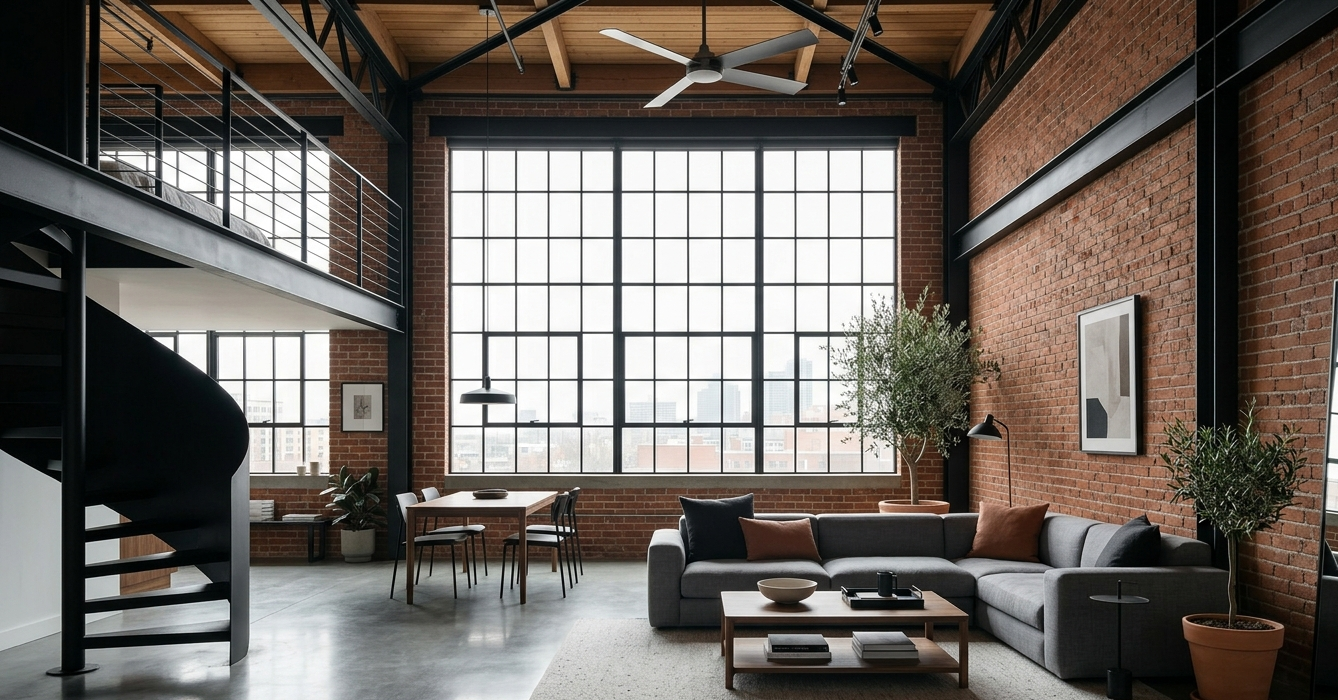
Industrial design isn’t about having a 5,000-square-foot open floor plan; it’s about a specific textural language and a philosophy of “honest materials.” In this guide, I’m going to show you exactly how to implement industrial loft decor ideas for standard suburban apartments without ever touching a sledgehammer.
The Origin of the Industrial Aesthetic: From Necessity to Luxury
Before we dive into the “how,” we have to understand the “why.” Industrial chic was born out of urban necessity. In the mid-20th century, artists began colonizing abandoned warehouses because they were cheap and offered incredible light. They didn’t hide the pipes or the brick; they embraced them.
Today, we translate that “warehouse soul” into modern residential spaces by focusing on spatial flow and visual weight. In a suburban setting, we aren’t trying to fake a factory; we are layering in the character of one.

The DNA of Industrial Design: Rawness and Refinement
To successfully transition a cookie-cutter apartment into a loft-inspired sanctuary, you must master the balance between the “hard” and the “soft.”
1. The Power of Textural Contrast
In my experience of styling, I’ve found that the biggest mistake people make is buying everything in the same finish. A room full of cold metal feels like a hospital; a room full of distressed wood feels like a rustic cabin. The “chic” in Industrial Chic comes from the friction between materials.
2. Exposed Elements (Even the Faux Ones)
If you don’t have real brick, don’t worry. High-quality 3D brick veneers or even strategically placed “limewash” paint can mimic the depth of aged plaster. The goal is to move away from flat, “perfect” walls.
3. Structural Honesty
Industrial design celebrates how things are made. Think of furniture with visible bolts, lighting with braided fabric cords, and shelving supported by iron plumbing pipes.
Deep Dive: The Industrial Color Palette and Material Science
When we talk about industrial loft decor ideas for standard suburban apartments, we are really talking about a sophisticated play of light and shadow.
The Master Color Palette
Industrial design isn’t just “grey.” It’s a spectrum of earthy, oxidized tones. In my projects, I use a 60-30-10 rule for color distribution:
- The Foundation (60%): Neutrals like Slate Grey or Warm Putty.
- Hex Suggestion:
#707070(Gauntlet Gray) or#A9A9A9(Concrete).
- Hex Suggestion:
- The Secondary Layer (30%): Deep, moody tones to provide “visual weight.”
- Hex Suggestion:
#2C2C2C(Oil-Rubbed Bronze) or#3E2723(Dark Espresso).
- Hex Suggestion:
- The Accent (10%): “Oxidized” colors that add warmth.
- Hex Suggestion:
#B7410E(Rust/Copper) or#4E5B44(Forest Moss).
- Hex Suggestion:
Fabric Choices: Softening the Steel
To prevent your apartment from feeling sterile, you must choose fabrics that have a “hand-feel.”
- Leather: Not shiny, “plastic-y” leather, but top-grain aniline leather that develops a patina. A “worn-in” cognac sofa is the ultimate industrial anchor.
- Canvas and Linen: Think heavy-duty painters’ drop cloths or Belgian linen. These provide a natural, organic counterpoint to metal furniture.
- Wool and Shearling: Use these for rugs or throws to introduce a cozy, “lived-in” vibe that contrasts with the coldness of steel.
“The Curator’s Choice”: 5 Essential Industrial Anchors
Over the years, I’ve curated hundreds of rooms. If you are starting from scratch in a suburban apartment, these five items are your “North Stars.”
| Item | Why It Works | Styling Tip |
| The Edison Bulb Chandelier | Instantly changes the “era” of the room. | Use a “Sputnik” style to add mid-century industrial flair. |
| Reclaimed Wood Coffee Table | Adds organic history to a modern floor. | Look for pieces with “live edges” or visible saw marks. |
| Metal Frame “Crittall” Mirror | Mimics the look of factory windows. | Lean a large arched version against a wall to double your light. |
| Distressed Persian Rug | Softens the “hard” edges of industrial furniture. | Choose a faded indigo or brick red to ground the room. |
| Task-Style Floor Lamp | Provides architectural height. | Use a matte black finish to create a strong silhouette against light walls. |
You might also enjoy:
- Timeless Interior Design: 7 Principles That Never Age
- The Ultimate Minimalist Home Office Design Guide
- Eco-Friendly Elegance: Sustainable Home Decor Guide
Room-by-Room Application: The Suburban Transformation
The Living Room: Creating the Focal Point
In a standard apartment, you likely lack a fireplace or a grand architectural feature. You have to create a focal point.
- The Wall: Use a dark, matte charcoal paint on the wall behind your TV or sofa. This adds depth and hides the “black box” of the television.
- The Seating: Opt for a low-profile sofa. Lower furniture makes your ceilings feel higher, mimicking that loft-like verticality.
The Kitchen: Industrial Utility
Suburban kitchens are often dominated by white cabinetry and laminate.
- The Hardware: Swap out standard chrome pulls for matte black iron or knurled brass. It’s a 20-minute DIY that changes the entire mood.
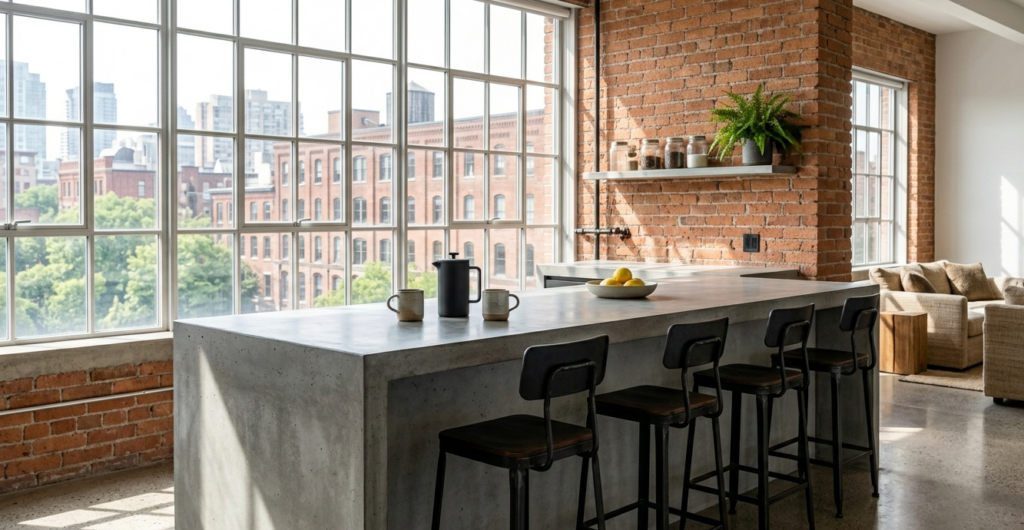
- The Island: If space permits, add a rolling stainless steel “chef’s table.” It provides extra prep space and that professional, “commercial kitchen” aesthetic.
- Lighting: Hang two oversized metal dome pendants over your counter. Scale is everything—don’t be afraid to go big.
The Bedroom: The “Soft Industrial” Retreat
You want the bedroom to be industrial but not cold.
- The Bed: A simple iron canopy bed frame creates a “room within a room” and adds architectural lines without taking up visual floor space.
- The Bedding: Layer grey jersey cotton with a heavy charcoal duvet.
- The Lighting: Use wall-mounted swing-arm lamps instead of bulky bedside table lamps. This keeps the lines clean and functional.
Pros and Cons of the Industrial Aesthetic
The Pros (Aesthetic & Functional)
- Durability: Industrial furniture is built to last. Scratches on a reclaimed wood table just add “character.”
- Timelessness: Unlike “ultra-modern” styles, industrial design is rooted in history. It doesn’t go out of style.
- Ease of Entry: You can find incredible industrial pieces at flea markets or through upcycling, making it budget-friendly.
The Cons (Maintenance & Mood)
- Dust Magnetism: Dark surfaces and open shelving require more frequent dusting than closed cabinetry.
- Acoustics: Industrial materials (metal, wood, brick) don’t absorb sound well. In a small apartment, you’ll need plenty of textiles (rugs, curtains) to prevent an echo.
- Visual “Coldness”: If not balanced with plants and warm light, the style can feel a bit “moody” or dark during winter months.
Mastering the “Small Details” That Make a Big Impact
When applying industrial loft decor ideas for standard suburban apartments, the devil is truly in the details.
The Greenery Factor
I always tell my clients that “Industrial” needs “Organic.” A large Fiddle Leaf Fig or a Monstera in a concrete planter breathes life into the space. The vibrant green pops beautifully against grey and brown tones.
The Art of the Gallery Wall
In a loft, you might have one massive 6-foot canvas. In an apartment, you might not have the wall space. Instead, create a gallery wall using black wood frames and architectural sketches or black-and-white photography. Use a grid layout to maintain that “ordered, factory” feel.
Expert Styling Tip: The “Rule of Three” Materials
In my experience, the most successful industrial rooms always feature three distinct materials in every “vignette” (a small styled area, like a bookshelf or coffee table).
The Formula:
- Something Cold (Metal, Glass, Concrete)
- Something Warm (Wood, Leather, Gold/Brass)
- Something Soft (Linen, Wool, Greenery)
If you have a metal desk, add a wooden organizer and a small potted plant. If you have a leather sofa, add a wool throw and a metal side table. This ensures the room feels balanced and intentional.
Conclusion: Finding the Soul in the Suburban
Transforming a standard apartment into an industrial sanctuary isn’t about where you live—it’s about how you see the materials around you. It’s about celebrating the beauty of an iron bolt, the history in a piece of grain, and the cozy mystery of a well-placed shadow.
By focusing on textural contrast, a moody color palette, and honest furniture, you can create a home that feels like a curated urban escape, no matter what your zip code says.