
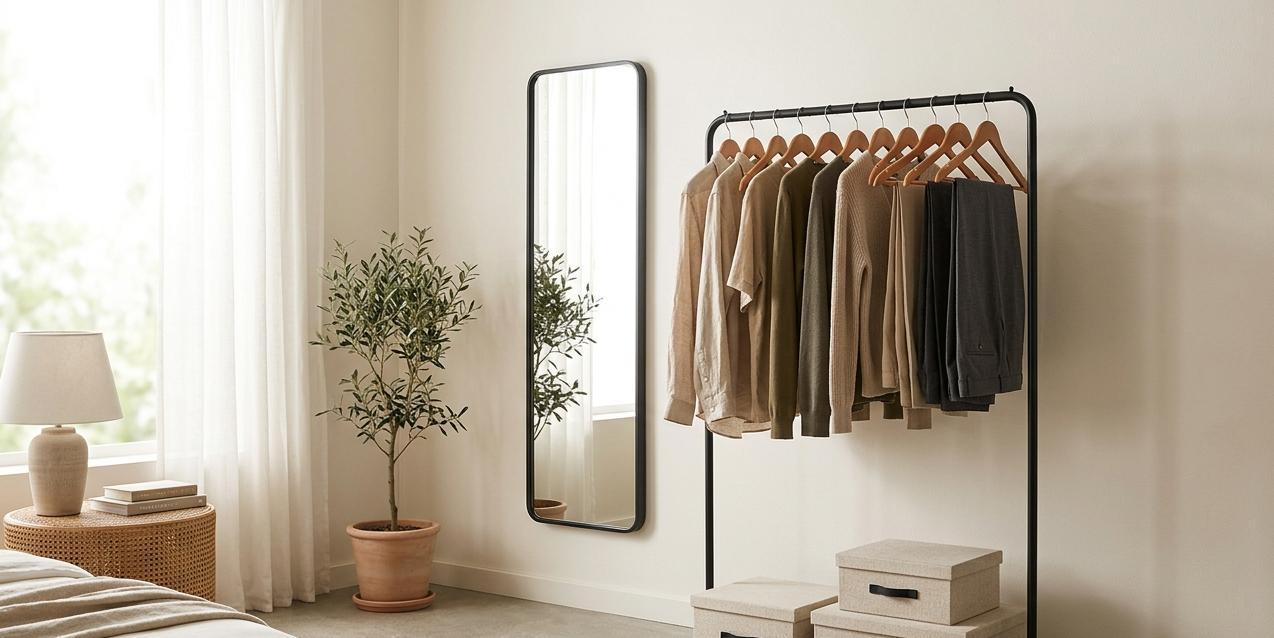
Welcome to the Smart Renovation Guide. I’m so glad you’re here, because today we are tackling one of the most common—and most frustrating—design dilemmas I’ve encountered as an interior designer: the “closet-less” bedroom.
If you are wondering how to organize a small closet with no drawers or shelving—or if you don’t have a closet at all—you’ve come to the right place. We are going to transform your bedroom from a cluttered mess into a curated sanctuary.
The Evolution of the “Open Wardrobe”: From Necessity to High-End Trend
Historically, the built-in closet is a relatively modern luxury. In the 18th and 19th centuries, people relied on heavy, ornate armoires and “clothespresses” to store their garments. These were considered pieces of fine furniture, often passed down through generations.
In the mid-20th century, modernism pushed storage behind closed doors, favoring the “hidden” look. However, we are currently seeing a massive shift back toward the “visible wardrobe.” Influenced by Minimalism, Industrial Chic, and the Japandi aesthetic, the open-concept closet has become a design statement in its own right. It’s no longer about hiding your mess; it’s about curating your belongings so they contribute to the room’s textural contrast and personality.

The Foundation of Closet-Free Living: Color, Texture, and Material
Before we dive into the “how-to,” we must discuss the “with what.” When your clothes are exposed, they become part of the room’s décor. To prevent the space from feeling chaotic, we need a strict adherence to color psychology and materiality.
The Designer’s Palette: Setting the Mood
In a small room with open storage, the color of your hardware and your walls will dictate whether the room feels “busy” or “boutique.” I always recommend a neutral backdrop to allow the textiles of your clothing to breathe.
- The “Quiet Luxury” Palette: Use soft, warm whites and “greiges” to create a sense of expansive space.
- Wall Color: Alabaster White (#F2F0E8)
- Hardware (Racks/Shelving): Matte Champagne Gold (#D4AF37)
- Accents: Soft Charcoal (#36454F)
- The “Organic Modernist” Palette:
- Wall Color: Pale Sage (#BCB88A)
- Hardware: Natural Light Oak (#D9B99B)
- Accents: Creamy Linen (#F5F5DC)
Fabric and Texture Selection
When you lack drawers, you will likely rely on bins and baskets. Texture is your best friend here. In my experience, mixing textures prevents a room from looking “flat.” I recommend:
- Heavyweight Linens: Use linen-covered storage boxes to hide away unmentionables. The tactile quality of linen adds a layer of sophistication.
- Hand-Woven Rattan: Incorporating wicker or seagrass introduces an organic element that softens the hard lines of garment racks.
- Velvet Hangers: This is a non-negotiable. Using uniform hangers—specifically slim velvet ones—creates visual continuity. It’s the single most effective way to make an open rack look like a high-end boutique rather than a laundry room.
How to Implement the 7 Creative Storage Hacks
When you’re figuring out how to organize a small closet with no drawers or shelving, you have to think vertically and multi-functionally.
1. The Sculptural Garment Rail
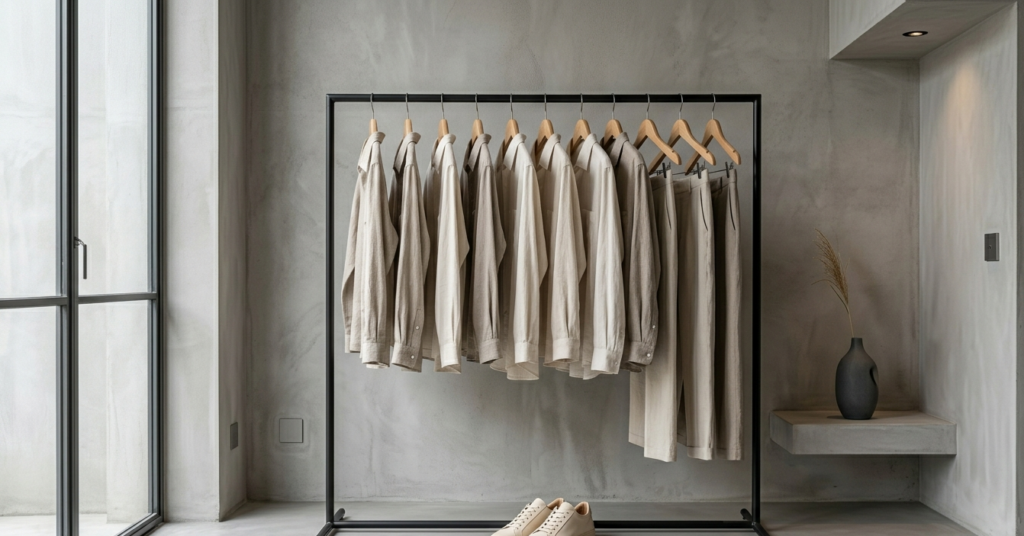
Instead of a cheap plastic rack, opt for a “Z-frame” or a ceiling-mounted brass rail. By hanging your most beautiful pieces—trench coats, silk dresses, linen shirts—you turn your wardrobe into a focal point.
2. The Bedside Armoire Hybrid
If you have no room for a dresser, replace your nightstands with tall, narrow “Lingerie Chests.” These provide drawers for smaller items while keeping the footprint minimal.
3. Under-Bed Architecture
The space under your bed is prime real estate. I prefer using long, wooden rolling drawers rather than plastic bins. It keeps the spatial flow clean and ensures the “renovated” look extends to every corner.
4. The “Floating” Boutique Shelf
Install a long floating shelf high above your headboard or garment rail. This is where you store “out of season” items in beautiful, labeled canvas bins.
5. The Corner Carousel
Utilize dead corners with a rotating shelving unit. This is an incredible hack for shoe collections, keeping them visible but tucked away.
6. The Mirror-Wardrobe Combo
Lean a large, floor-length “leaning mirror” against the wall. Some models come with hidden hooks and a small rail behind the glass. It’s a secret storage win that also bounces light around the room.
7. The Pegboard Wall
A floor-to-ceiling wooden pegboard allows you to move shelves and hooks around as your needs change. It’s the ultimate “living” storage solution.
You might also enjoy:
- The Art of the Shelfie: How to Style Open Shelves
- The Grown-Up Playroom: Hidden Toy Storage Ideas
- Entryway Efficiency: Best Organization Stations
Deep Dive: Mastering the “Visible” Wardrobe
The Psychology of Curation
When your wardrobe is visible, you are forced to become a better editor of your own life. I’ve found that clients who move to open storage systems often report lower stress levels. Why? Because you can only keep what you actually love and wear. This is the “Boutique Effect.”
Lighting Your Storage
To make an open storage area feel intentional, you must light it. Accent lighting is the difference between a “closet” and a “gallery.”
- LED Strip Lighting: Run these behind a garment rail or under floating shelves. Aim for a warm temperature (2700K) to keep the room cozy.
- Picture Lights: Install a battery-operated picture light above your main hanging rail to highlight your favorite textures.
The Curator’s Choice: 5 Essential Accessories for Closet-less Bedrooms
In my professional opinion, these five items are the “holy grail” for anyone living without a traditional closet.
- The Canvas Trunk:
- Why I love it: It serves as both a coffee table (or bench) and deep storage for bulky sweaters or spare linens. Look for versions with leather straps for an equestrian, high-end feel.
- The Acrylic Shelf Divider:
- Why I love it: If you have open shelving, these invisible dividers keep stacks of jeans or sweaters perfectly vertical. It maintains the visual harmony without adding bulk.
- Industrial S-Hooks:
- Why I love it: Perfect for hanging jeans by the belt loops or displaying a collection of handbags on a rail. They add a touch of “loft-style” edge.
- The Over-the-Door Valet:
- Why I love it: Not the flimsy plastic ones! I’m talking about heavy-duty iron hooks. I use these to “set the stage” for the next day’s outfit, which adds an element of personal ritual to the room.
- Aromatic Cedar Blocks:
- Why I love it: Since your clothes are out in the open, you want them to smell divine. Cedar blocks or dried lavender sachets tucked into your open bins provide a sensory experience every time you walk by.
Room-by-Room Application: Beyond the Bedroom
The principles of organizing without built-ins can be applied throughout the entire “Smart Renovation” home.
The Living Room
In the living room, we apply the “Open Wardrobe” concept to media and books. Instead of a bulky entertainment center, use floating shelves and decorative baskets. The goal is to maintain spatial flow by keeping the floor as visible as possible, which trick the eye into thinking the room is larger.
The Kitchen
The “no-cabinet” kitchen is a major trend. We use hanging pot racks and magnetic knife strips. Much like the bedroom garment rail, the kitchen becomes a display of utility. I suggest grouping items by material—all copper together, all ceramic together—to create a curated look.
The Entryway
Most small homes lack a coat closet. We solve this by creating a “landing strip.” A narrow console table paired with a series of high-end wall hooks creates a functional zone without the need for a structural closet.
Pros and Cons: The Open Storage Lifestyle
| Feature | Pros (Aesthetic & Functional) | Cons (Maintenance & Reality) |
| Visibility | Everything is easy to find; creates a “boutique” vibe. | Requires constant tidiness; dust can accumulate on clothes. |
| Spatial Flow | Removes heavy, boxy furniture; makes the room feel airy. | Can look cluttered if the color palette isn’t cohesive. |
| Customization | Easy to change the layout as your style evolves. | Requires high-quality hangers and bins to look “expensive.” |
| Cost | Usually cheaper than building a structural closet. | High-quality “statement” racks can still be an investment. |
Expert Styling Tips for Success
If you’re struggling with how to organize a small closet with no drawers or shelving, my number one expert tip is this: The Rule of Three.
When styling an open shelf or a garment rack, group items in threes. Three hats on a shelf, three pairs of shoes on a mat, or three color-coordinated coats. This creates a sense of intentionality.
Furthermore, don’t forget the power of scent. In a room where your clothes are “out,” the atmosphere is everything. Use a high-end room spray or a diffuser to ensure the space feels fresh. A “stale” room will make even the most beautiful open wardrobe feel like a cluttered corner.
Conclusion: Embrace the Openness
Living without a closet isn’t a limitation; it’s an invitation to live more intentionally. By focusing on textural contrast, visual harmony, and a strictly curated color palette, you can turn your storage needs into the most beautiful part of your home.
Remember, a room’s beauty doesn’t come from what you hide away—it comes from how you display the things that make you, you.
Are you ready to transform your bedroom?
- Step 1: Purge anything you haven’t worn in 12 months.
- Step 2: Choose your “hardware” finish (Gold, Black, or Wood).
- Step 3: Buy those velvet hangers!