
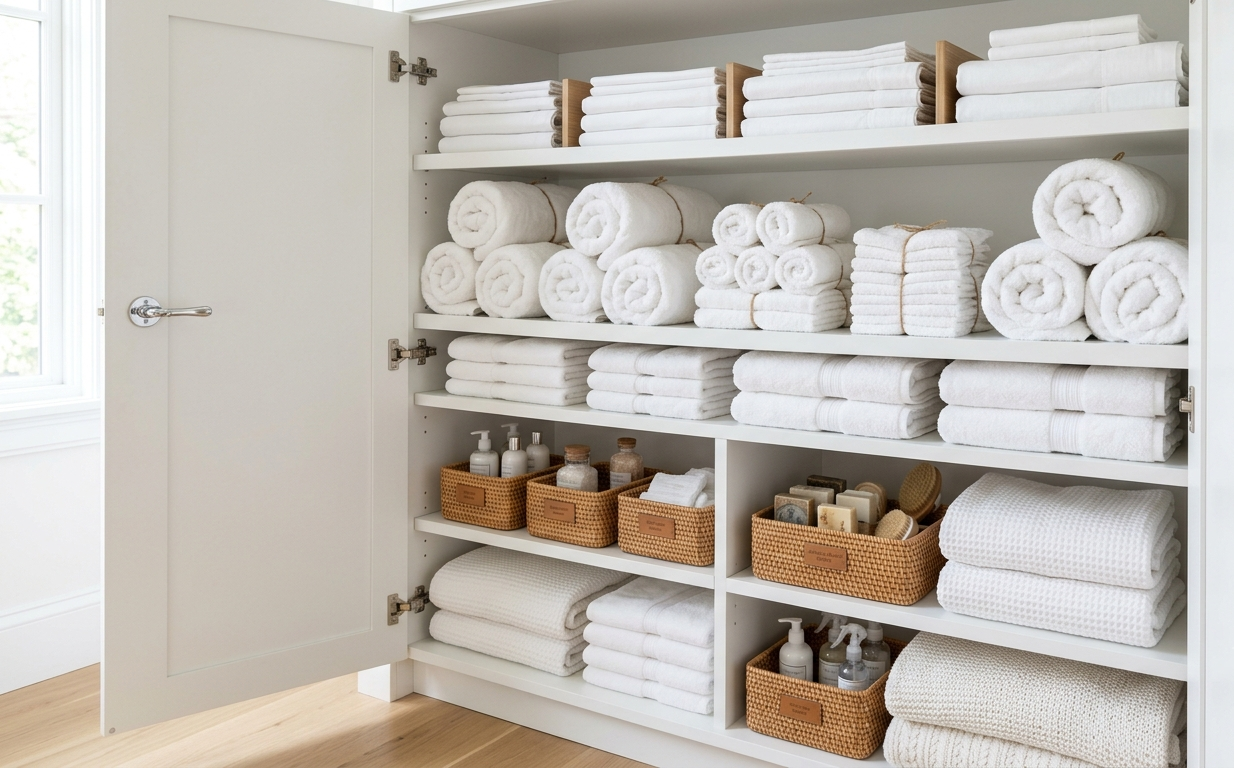
We have all experienced that specific moment of pure, unadulterated bliss: walking into a boutique luxury hotel room, opening the wardrobe or bathroom console, and finding a perfectly curated stack of crisp, fragrant, impeccably folded linens. It is an experience that instantly signals calm, indulgence, and order.
Now, contrast that with the reality many of us face at home on a frantic Sunday evening. You open your linen closet door, only to be greeted by an avalanche of mismatched fitted sheets, a rogue beach towel from 2018, and a tangled web of pillowcases. It is a visual chaos that disrupts our mental peace.
Welcome to The Luxury Hotel Method. In this comprehensive guide, we will explore sophisticated linens and towel organization ideas that elevate your storage from chaotic to curated, blending high-end aesthetic principles with functional everyday styling.
Core Elements of the Luxury Hotel Method
Achieving a high-end look requires an understanding of fundamental interior design principles: symmetry, contrast, and rhythm. Here are the foundational elements you need to establish before restructuring your space.
1. Visual Monomorphism
In design, monomorphism refers to maintaining a consistent form and style. To achieve a hotel-grade aesthetic, your linens should speak the same visual language. This does not mean you must throw away everything you own and buy only white sheets, but it does mean establishing a strict color story and material standard.
2. The Uniform Fold
The greatest secret of luxury hotels is the fold. Mismatched folding techniques create jagged lines, uneven stacks, and visual noise that disrupts your closet’s focal point. Every towel, sheet set, and pillowcase must be folded using identical dimensions to create clean, architectural edges along the front shelf line.
3. Strategic Zoning
Aesthetics cannot exist without functional styling. Arrange your shelves based on the human body’s natural ergonomics:
- The Prime Zone (Eye and Waist Level): Reserved for your everyday essentials—frequently changed sheet sets and bath towels.
- The Upper Zone (Above Eye Level): Dedicated to lightweight, seasonal items like summer linen blankets or extra pillowcases.
- The Lower Zone (Below Waist Level): Ideal for heavy quilts, extra duvet inserts, or structured storage baskets containing utilitarian items.
Deep Dive: Textures, Fabric Choices, and Color Palettes
To elevate your closet from a standard storage unit to a high-end design feature, we must look closely at the sensory elements. The interplay of fabric weaves, color psychology, and textural contrast defines the luxury experience.
The Psychology of the Linen Color Palette
Color is the fastest way to communicate luxury to the subconscious mind. While crisp hospitality white is the timeless standard, contemporary interior design allows for a richer, more nuanced palette. The key is to select soft, desaturated tones that evoke a sense of organic tranquility.
Here is a curated palette inspired by elite eco-resorts, complete with hex codes to help you visualize your textile or shelf paint selection:
- Chalk White (
#F7F7F7): The ultimate clean foundation. It reflects light efficiently, instantly making tight closet spaces feel larger and more airy. - Alabaster Mist (
#EAE6DF): A warm, sophisticated off-white with subtle grey undertones that softens the starkness of pure white. - Muted Sage (
#9A9F8C): A serene, biophilic green that introduces a calming, organic element to your storage space. - Warm Taupe (
#B3A79A): A grounding earth tone that pairs beautifully with natural wood shelving and woven fibers. - Faded Slate (
#7F878E): A soft, smoky blue-grey that adds depth and a classic, coastal elegance without feeling overly dark.
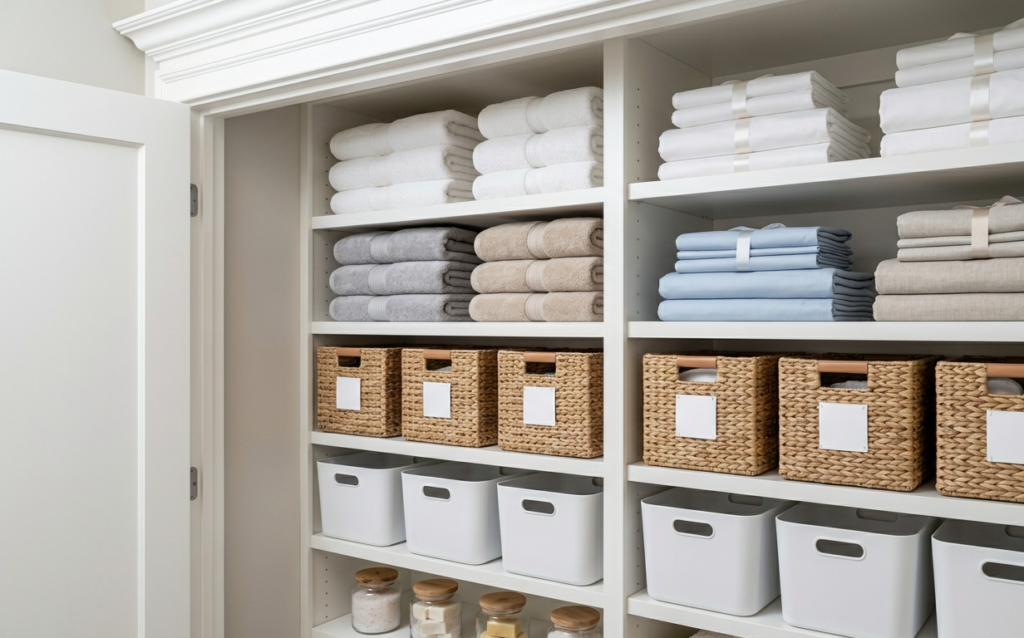
When organizing your closet, arrange your linens in a deliberate gradient. Start with your lightest whites on one side or top shelf, and gently transition to your deeper earth tones. This creates a cohesive, flowing visual narrative that is incredibly pleasing to the eye.
Textural Contrast and Fabric Selections
A premium linen closet should be a tactile wonderland. In my styling practice, I always emphasize textural contrast to keep monochrome or neutral spaces from looking flat and uninspired. Combining different weaves adds visual dimension and sophisticated depth.
Long-Staple Cotton (Percale vs. Satin)
For sheets, long-staple cotton is the gold standard.
- Percale offers a crisp, matte, cool-to-the-touch finish that resembles high-end European boutique hotels. When folded, percale edges look sharp, structured, and architectural.
- Sateen features a softer, silkier drape with a subtle sheen. It reflects light beautifully, which can add a touch of glamour to dimly lit closets. Stacking these two weaves alternately creates a delightful interplay between matte and satin surfaces.
French Flax Linen
Linen introduces a relaxed, organic texture into your closet. Its slightly slubbed, tactile surface softens the rigidity of ironed cotton sheets. To keep linen looking luxurious rather than messy, use a loose “soft square” fold rather than a hard, pressed crease.
Heavy-Wound Turkish Cotton Towels
Your towels should feel like a plush cloud. Opt for high-GSM (Grams per Square Meter) Turkish cotton with a dense loop structure. The sheer volume of these towels adds immediate substance to your shelving, creating those deep, thick horizontal lines characteristic of five-star spa resorts.
How to Implement the Luxury Hotel Method: A Step-by-Step Guide
Transforming your closet requires a systematic approach. Set aside a weekend afternoon, put on your favorite playlist, and follow this designer-tested methodology.
Step 1: The Absolute Purge
Remove every single item from your closet. In my experience, we only use about 40% of the linens we store. Evaluate each item against the luxury standard.
- Retain: Matching sheet sets in excellent condition, plush towels free of fraying, and functional seasonal bedding.
- Repurpose or Donate: Stained or mismatched pillowcases, threadbare towels, and sheets that fit beds you no longer own. (Animal shelters are excellent places to donate older towels).
Step 2: Surface Refinement and Lighting
Before putting anything back, look at the blank canvas of your closet. Utilitarian wire shelving is the enemy of the luxury aesthetic; it leaves unsightly indentations on your pristine towels and feels cold.
If you have wire shelving, consider retrofitting them with solid wood liners or wrapping them in heavy-duty linen contact paper. If budget allows, paint the interior of your closet in a warm, welcoming shade like Alabaster Mist.
The Role of Ambient Illumination
Lighting is often overlooked in closet design, yet it makes a dramatic difference. Swap out harsh, yellow overhead bulbs for a crisp, neutral white light (around 3000K). For a truly high-end feel, install motion-activated LED strip lighting underneath your shelves. When you open the door, your linens will be bathed in a soft, ethereal glow, instantly spotlighting your beautifully organized stacks.
Step 3: Master the Hospitality Folding Techniques
To achieve uniformity, implement these two signature folds:
The Classic Hotel Sheet Tri-Fold
- Lay your flat sheet or duvet cover completely flat on a large surface.
- Fold it in half lengthwise, then fold it in half lengthwise again, creating a long, narrow rectangle.
- Bring the outer edges into the center, then fold it into thirds.
- The Golden Rule: Always place the sheet onto the shelf with the rounded, smooth folded edge facing out toward you. Hide the messy, open edges at the back of the closet.
The Spa Towel Roll vs. The Clean Book Fold
- The Clean Book Fold (Best for structured shelving): Fold your bath towel in half lengthwise, then fold it into thirds lengthwise. Finally, fold the long strip into thirds horizontally. You will be left with a thick, plush square. Stack these no more than 3 to 4 high to prevent leaning.
- The Spa Towel Roll (Best for deep baskets or open cubbies): Fold the towel in half lengthwise. Take one corner and fold it down diagonally to create a point. Flip the towel over, roll it tightly starting from the straight end toward the pointed end, and tuck the point securely into the roll.
Step 4: Curation and Scent Architecture
A true luxury resort engages all the senses. Introduce a signature scent into your linen closet. Avoid harsh, synthetic chemical sprays. Instead, opt for natural linen mists infused with pure essential oils like lavender, white tea, cedarwood, or bergamot. Spray your shelves lightly before arranging your linens, or place a beautiful ceramic diffuser stone or a bundle of dried French lavender in the corner of a shelf.
You might also enjoy:
- The Art of the Shelfie: How to Style Open Shelves
- Entryway Efficiency: Best Organization Stations
- Deep Dive: Under-Sink Organization for Vanities
“The Curator’s Choice” — Elite Accessories for Linen Spaces
To elevate your storage to an art form, you need the right structural accessories. These elements introduce sophisticated materials—such as woven rattan, high-end acrylic, and natural linens—that beautifully complement your textiles.
Below is my carefully selected curation of the five best accessory types to incorporate into your design layout.
1. Canvas-Lined Rattan Baskets
Plastic storage bins can trap moisture and ruin the upscale feel of your space. Instead, opt for hand-woven rattan baskets lined with crisp canvas. The rattan brings an essential organic texture and warmth into the closet, balancing the softness of the fabrics. The canvas lining is crucial: it prevents the rough wicker from snagging delicate silk or high-thread-count cotton pillowcases.
2. Heavy-Gauge Acrylic Shelf Dividers
If you struggle with towering stacks of towels leaning or merging into one another, clear acrylic dividers are a game changer. They offer invisible support, creating the illusion of perfectly straight, freestanding columns of fabric. Because they are completely transparent, they do not block light or disrupt the clean visual lines of your shelves.
3. Linen-Wrapped Storage Boxes with Magnetic Closures
For items you don’t use regularly—such as winter wool blankets or guest bedding—open shelves can collect dust. Beautiful linen-wrapped storage boxes provide a sophisticated solution. They conceal colorful or bulky items while maintaining the textile-focused theme of the closet. The magnetic closure adds a satisfying, high-end sensory click when opened and closed.
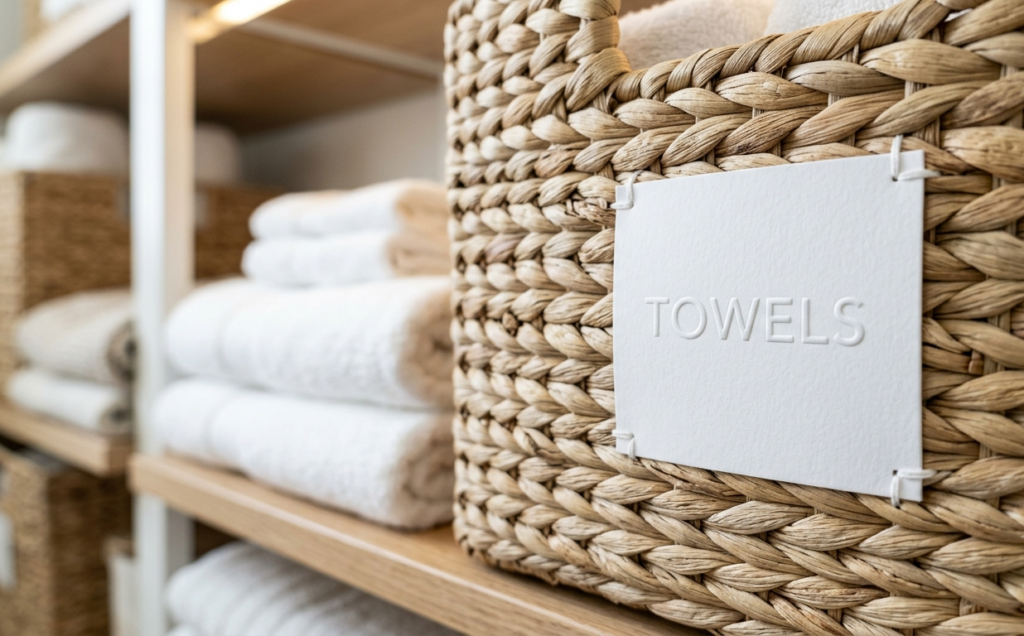
4. Minimalist Leather-Bound Brass Label Tags
Labeling is essential for keeping a linen closet organized over time, but sticky paper labels can look cheap. Elevate your organization with bespoke brass and leather tags looped over your woven baskets or hung from shelf edges. Engrave or neatly print labels like “KING PERCALE” or “GUEST TOWELS.” This small, intentional detail immediately communicates bespoke interior design.
5. Turned-Wood Blanket Ladders
When closet space is limited, look to your vertical wall space. A beautifully crafted wooden blanket ladder allows you to turn your finest textiles into an intentional decor feature. Draping a waffle-weave linen throw or a plush Turkish towel over the smooth, rounded rungs showcases the fabric’s drape and texture, adding warmth and comfort to the room.
Room-by-Room Application of the Luxury Hotel Method
The beauty of mastering linens and towel organization ideas is that this method isn’t restricted to a single closet. You can extend these principles throughout your home to create a seamless, cohesive lifestyle experience.
The Bedroom: The Master Sanctuary
In the bedroom, the Luxury Hotel Method is all about streamlining your linen changes and enhancing the look of your bed.
- The Bundle System: Store your entire sheet set folded neatly inside one of its matching pillowcases. This keeps the fitted sheet, flat sheet, and extra pillowcase grouped together in a sleek, self-contained envelope. No more hunting for missing pieces.
- The Foot-of-Bed Bench: If you have an upholstered or wooden bench at the foot of your bed, consider placing a pair of linen-wrapped boxes underneath it. This keeps an extra duvet insert or seasonal blanket within arm’s reach while adding a beautifully layered look to your bedroom layout.
The Living Room: Cozy Textural Curation
Living rooms often fall victim to “throw blanket clutter,” where blankets end up balled up on the sofa or spilled across the floor.
- The Structured Roll: Instead of tossing blankets over the back of the sofa, fold them in thirds lengthwise and roll them into tight, neat cylinders. Place these rolls vertically inside a large, beautiful ceramic vessel or a structured woven basket next to the fireplace.
- Pillow Cover Rotation: Keep your seasonal throw pillow covers organized in your main linen closet using the “book fold” method. This allows you to swap them out easily, updating your living room’s color story instantly without storing bulky, full-sized pillows.
The Kitchen: Culinary Textile Sophistication
Kitchen towels are often treated as pure utility, crammed into a messy drawer. You can easily elevate this daily workspace with a few simple shifts.
- The Uniform Drawer Grid: Dedicate a shallow drawer to your kitchen textiles. Use small bamboo drawer dividers to create a grid. Fold your tea towels into neat, compact rectangles and file them vertically (like a filing cabinet) rather than stacking them top-to-bottom. When you open the drawer, you can see every towel clearly, and pulling one out won’t disturb the rest.
- Material Harmony: Choose linen or waffle-weave cotton tea towels in a color palette that complements your kitchen cabinetry or countertop stone. Hanging one beautifully folded towel over the oven handle or apron-front sink instantly adds a thoughtful, styled touch.
Pros and Cons: Style vs. Maintenance
While the Luxury Hotel Method creates a stunning visual result, it is important to look at how it balances design aesthetics with daily upkeep.
Pros
- Instant Stress Reduction: Opening a beautifully organized, visually harmonious closet reduces visual noise and creates a sense of calm in your daily routine.
- Extended Textile Lifespan: Storing linens with proper breathing room prevents fabric degradation, yellowing, and musty odors. Acrylic dividers and breathable baskets protect delicate fibers from snags.
- Effortless Guest Prep: Welcoming overnight guests becomes stress-free when you can easily grab a perfectly curated, fresh set of sheets and towels in seconds.
- Financial Efficiency: When you can see exactly what you own, you avoid buying duplicate items you don’t need, allowing you to invest your budget in higher-quality textiles.
Cons & Mitigation
- Initial Time Investment: Implementing this system requires a few dedicated hours of purging, cleaning, and precision folding. The Solution: View it as an investment in your home’s peace of mind—a mindful ritual that pays off every single day.
- Upkeep Discipline: Family members or housemates may not always follow the uniform folding style. The Solution: Keep the system simple. Use clear brass labels on baskets so everyone knows exactly where things go, even if their folding isn’t perfectly hotel-grade.
- Wrinkle Management: Natural fibers like cotton and linen can wrinkle when folded tightly. The Solution: You do not need to iron your sheets every week. Simply misting your folded stacks with a little distilled water mixed with lavender oil relaxes the fibers naturally while they sit on the shelf.
Conclusion: The Ultimate Designer Secret
In my 15 years of transforming residential spaces, I have found that true luxury is rarely about buying more things. Instead, it is about elevating the items you already own and appreciating the spaces that are normally hidden away. The Luxury Hotel Method is more than just an organization project; it is a commitment to bringing beauty, order, and comfort into your daily home life.
Expert Tip: The “One-In, One-Out” Textile Rule
To maintain your beautiful closet long after the initial organization project, implement the strict “One-In, One-Out” rule. The moment you purchase a new, ultra-plush bath towel or a fresh set of percale sheets, choose an older item from your collection to retire, donate, or recycle. This simple boundary keeps your shelves perfectly balanced and ensures your linen space remains a serene, curated sanctuary.